
What the labels mean.
Indica, sativa, and hybrid mostly describe a plant's family tree and how it grows. They're traditional labels for how a plant looks and grows, not a measurement of anything inside it.
- Indica
- Traditional label for shorter, bushier plants with broad leaflets
- Sativa
- Traditional label for taller, lankier plants with narrow leaflets
- Hybrid
- A cross of both lineages. Most modern strains are hybrids.
Hemp vs. cannabis is a legal line set by delta-9 THC content. Indica, sativa, and hybrid are informal lineage and growth-habit labels. Different kinds of labels entirely.
What the studies found.
Studies comparing those labels with genetic and lab data found they often don't line up. These are the three our FAQ cites:
- Sawler et al., 2015. The genetic structure of marijuana and hemp. PLOS ONE.
- Watts et al., 2021. Cannabis labelling is associated with genetic variation in terpene synthase genes. Nature Plants.
- Smith et al., 2022. The phytochemical diversity of commercial Cannabis in the United States. PLOS ONE.
Strains have been cross-bred for decades, and the same name can differ from one grower to the next. A name on a jar is a starting point. It isn't a promise.
Why our menu still shows it.
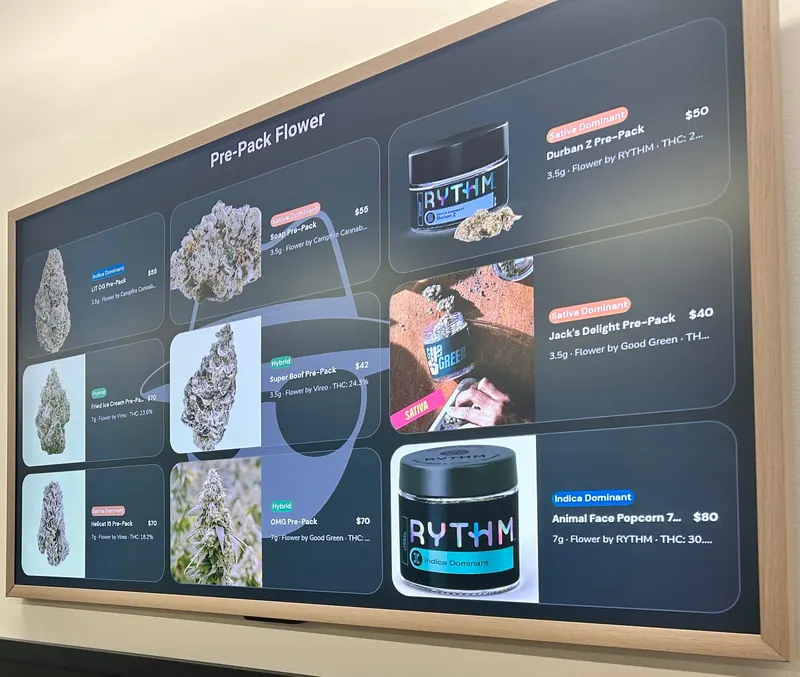
Our menu still shows which way a strain leans (Sativa, Sativa-dominant, Hybrid, Indica-dominant, Indica), because it's familiar shorthand. Pre-rolls carry the same lineage label. Those labels describe the plant and its aroma and flavor, not what it will do for you.
The lean is a fine way to sort a long menu. It's a rough way to guess how anything will feel.
Don't trade one label for one number.
Dropping the lean doesn't mean shopping by THC alone. THC is the easiest number to compare on a menu, but it is not a complete description of the product. Cannabis flower also contains minor cannabinoids such as CBD, CBG, CBC, and CBN, plus terpenes and other volatile compounds that help shape aroma and flavor. A higher number means stronger, not better.
Format, onset, duration, serving size, and your own experience all matter. That's why the list below has four things on it, not one.
What to look at instead.
- Total THC and CBD on the label.
- The top terpenes, when listed, and how the flower smells to you.
- The format. Inhaled products usually start within minutes, while edibles can take up to 2 hours.
- Your own notes on batches you liked.
Terpenes are natural aroma compounds made by many plants, including cannabis. They're a big part of why one strain smells like citrus and another like pine or pepper. THC and CBD on their own have almost no smell, so what you're smelling is mostly terpenes. The same ones show up across nature: limonene in citrus peel, pinene in pine needles, linalool in lavender (Booth et al., 2020).
Our terpenes guide and the terpene FAQ have the full aroma table.
How to use it at the counter.
Check the menu
Every strain shows its THC numbers and, when the lab reports them, the top terpenes. Start on the flower menu.
Smell it
When you shop, smell the flower and check the top terpenes on the label. Plenty of people find they have favorite aromas, and that's a good way to find products you like.
Ask about the batch
Ask a budtender about a specific batch. We'd rather slow down than guess.
Keep notes
The strain, the THC %, how much, and how it went. It makes the next visit easier.
Everyone is different, and the same person can react differently from one day to the next. Start with less, especially if you're new or it's been a while.